Automation On Grower Staff Labor
Labor is one of the biggest costs growers have.
Reducing and optimizing labor costs are keen on every grower’s mind. Especially starting with the labor in the nursery or greenhouse for production or picking or plant maintenance.
However, one area that is sometimes overlooked is staff labor in manual data entry.
The hours your staff spends in manually entering data into spreadsheets or your ERP software system screens is necessary, and it can add up to big costs on your operation.
Data automation projects can help you reduce that so your staff can spend more times on the important things that drive your business.
Data Automation in practice
Grower ERP software System entities such as sales orders, purchase orders, work or crop orders, item routings/costing and similar are all necessary in practice but can be tedious and very time consuming on the part of your back office staff to hand enter.
With the correct foundational data and system support, some of these transactions can be automated (at least from the data entry side).
A real-world example
We worked with a larger grower customer who has a brand name commercial ERP software system. There were many screen transactions that take a lot of employee time with manual entry. Over the last couple of years, we have been able to help with automation in some areas to reduce or eliminate hand entry of certain system entities in some cases.
In this analysis we will show the impact on our automated work for four record types for this customer:
- Sales Order and Sales Order Lines
- Purchase Order and purchase order lines
- Work Orders
- Item Routing/Costing and detail records
In each of the cases, the system has a ‘header’ screen where the information about the overall record is entered (like the sales order customer and dates etc.) and screen for the ‘details’ like the sales order line-item details (qty, price, discounts, delivery date, etc.). In this analysis, to calculate the person hours impacted, we assume a reasonably competent worker can enter a ‘header’ record on average in 15 seconds and a ‘detail’ line record in 20 seconds.
The following table shows the results from our automated record generation and the impact it had on the office labor.
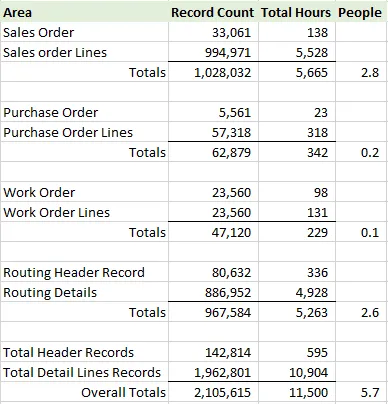
Figure 1: Automation Project Results
Copyright Advanced Grower Solutions
Based on these assumptions over just a 2.5-year period we were able to save this grower an estimated 11,500 person-hours totaling 5.7 total full-time equivalent (assuming 2,000 work hours per year for normal back office staff). AGS automation tools helped generate a total of 2.1 million data records over that period.
If we assume that the average salary was 48,000 ** / year (just to make the math easy) you end up with the following actual savings.
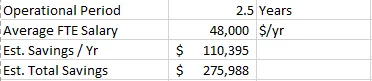
Figure 2: Automation Project Cost Saving Results
Copyright Advanced Grower Solutions
Obviously, each grower and each geographical region may be different scales of pay or salary costs, but this example illustrates a reasonable example of the type of labor savings with data automation projects like this, either allowing running with reduced headcount or applying those hours to higher value activities.
So, you can see that even if your automation project costs thousands of dollars, the return on that investment can be really high over a couple of years.
Data plus rules plus code equals automation
This type of result does have some pre-requisites to achieve these results. In general:
- Foundational data available and accessible for automation
- Database of some type that data can be entered in a programmatic fashion (database connection or an API)
- Rules that can be applied to your foundational data or intermediate datasets to transform
- An execution environment to schedule and execute the code to run against your internal data (lIke a windows or Linux server).
Part of the typical project implementation will involve some of this setup as well as the coding for the specific data and operations you need.
What about your automation
If you have a lot of manual data operations, in some cases we might be able to help with reducing or eliminating the effort.
Contact us to find out more about our data automation consulting and how we might be able to help your operations improve data efficiencies.
** Just for illustrative purposes this is not the actual average salary for those customer employees. Your actual results may be different salaries or rates.